






Mining firm Cango sold 4,451 BTC on the open market, roughly 60% of its 7,476-BTC reserves.
We’ve taken a deliberate step to support the next phase of our transformation:
📌Balance sheet optimization: Completed the sale of 4,451 BTC, generating approximately US$305 million in net proceeds to reduce financial leverage and fund future growth initiatives.
📌Leadership…
— CANGO (@Cango_Group) February 9, 2026
Settlement was in the stablecoin USDT. The entire proceeds—about $305 million—were used to repay a bitcoin-secured loan.
“The sale of part of the bitcoin assets was carried out in order to strengthen the balance sheet and reduce leverage, which will provide additional opportunities to finance the company’s strategic expansion in artificial-intelligence computing infrastructure,” the press release said.
After offloading a sizeable portion of its crypto reserve, Cango CEO Paul Yu outlined the next phase of the company’s strategy in a letter to shareholders.
Building on today’s Bitcoin sale update, our CEO Paul Yu shared a new Shareholder Letter outlining how we’re thinking about Cango’s next chapter.
Over the past year, we focused on building a solid foundation—scaling to 50 EH/s, tightening operations, exiting legacy businesses,… pic.twitter.com/TVhX69gOA0
— CANGO (@Cango_Group) February 9, 2026
“Demand for AI is growing rapidly. The capacity of power systems and grids is not. We see a widening gap in power supply and believe that a globally distributed, grid-connected infrastructure like ours can help bridge it,” the chief executive emphasized.
The approach he presented envisages:
- in the near term — deploying containerised modular solutions to run AI workloads;
- in the medium term — building a software-defined platform to integrate distributed compute into a single enterprise network;
- in the long term — scaling the initiative globally to generate stable cash flow.
Mining operations will underpin the AI push. In crypto mining, Cango will focus on efficiency and on balancing installed hash rate (50 EH/s) with operating capacity (~36.6 EH/s on average last week).
In January the company mined 496 BTC.
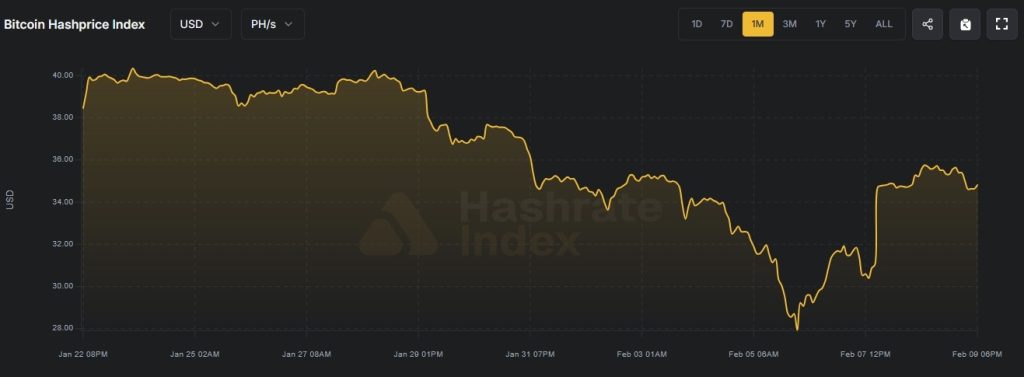
At the start of February, industry players began mass shutting down equipment amid a drop in mining profitability. After an 11% network difficulty adjustment on 7 February and bitcoin’s rebound from a local low around $60,000, hashprice recovered from about $27 per PH/s per day to roughly $35.
Not everyone is surviving at today’s profitability levels.
NFN8 files for bankruptcy
Mining company NFN8 Group and its subsidiaries filed for Chapter 11 bankruptcy protection in Texas, TheMinerMag reported.
The firm owns more than 5,000 unencumbered bitcoin-mining rigs and also operates thousands of leased machines.
A key feature of NFN8’s business was selling mining equipment while simultaneously taking it back on lease. Payments were funded by mining revenue, making the structure highly sensitive to uninterrupted equipment uptime and to hashprice.
A series of events worsened the firm’s finances. In mid-2023, Core Scientific, which was undergoing restructuring, terminated a hosting agreement with NFN8. As a result, some of the machines the miner managed were temporarily switched off. After a deal with an alternative provider, about 95% of device owners agreed to revised terms.
After the halving in April 2024, mining profitability fell sharply and recovered significantly more slowly than in previous cycles. By June 2024, NFN8’s revenue was insufficient to cover operating costs and lease payments, which were suspended.
Payments resumed after a few months, but in late 2025 the company again faced liquidity problems. A fire at a leased data centre in Crystal City, Texas, cost the firm roughly 50% of its mining capacity and a similar share of revenue. The timing of insurance payouts remains unknown.
In October 2024, three NFN8 counterparties sued it, alleging breach of contract, securities-law violations and fraud. The case was sent to arbitration. Chief restructuring officer Eric White believes the proceedings will be costly for the company and could end with debts being awarded against it.
According to NFN8’s filing, it has less than $50,000 in assets and liabilities of no more than $10 million.
In Russia, news surfaced of the possible bankruptcy of bitcoin miner BitRiver.