

Bitcoin miners are widely encountering losses due to declining profitability. To survive, they must either switch to AI hosting or learn to manage bitcoin reserves as working capital, according to Wintermute.
Structural Crisis in the Business Model
For the first time in a four-year cycle, digital gold has not yielded double profits, which usually offset the decline in income after the halving. The peak gross margin coincided with levels previously characteristic of a bear market bottom.
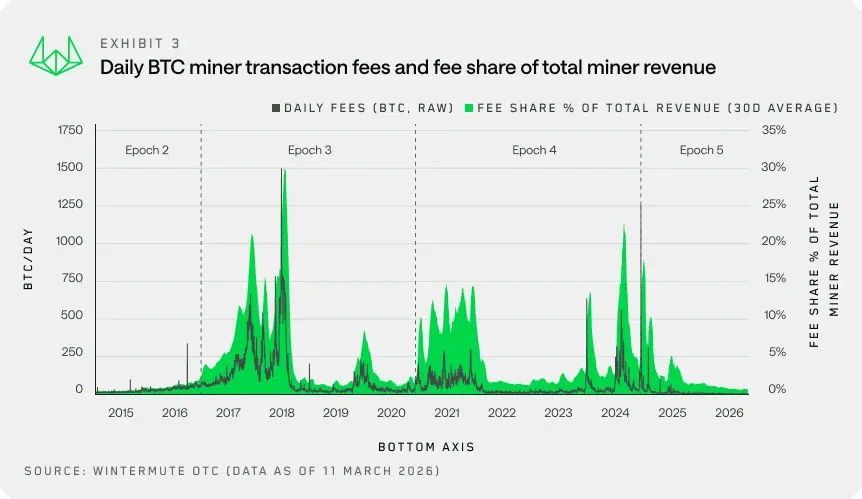
Fees are unable to cover costs—they account for about 1% of the companies’ total revenue. Miners also continue to face consistently high energy costs.
Passive Holding as a Legacy of the HODL Era
According to Wintermute, miners collectively control about 1% of the total bitcoin supply. Analysts call this the “legacy of the HODL era,” noting that the full arsenal of treasury management remains practically unused.
Traditionally, tools for generating income in the crypto market were limited to staking and the DeFi sector. However, experts have proposed a broader toolkit for miners:
- monetizing market risk through derivatives;
- selling covered call options;
- cash-secured put options;
- passive placement in credit protocols for interest.
“Active balance management is the most underestimated lever for miners. Those who turn bitcoin from a passive reserve into a working asset will gain a structural advantage by the next halving,” Wintermute believes.
Artificial Intelligence
An alternative is artificial intelligence. Mining companies have spent years building energy infrastructure in regions with cheap electricity. As a result, they have become owners of a resource critically needed by the AI industry and which cannot be quickly created from scratch.
The shift to renting capacities for neural networks has already begun. In March, Core Scientific announced the sale of all its bitcoins and secured a $500 million loan from Morgan Stanley. The firm will allocate most of the proceeds to re-equip data centers for AI needs.
Other players, including Riot Platforms, MARA Holdings, Terawulf, Cango, and many others, have previously taken similar steps.
Wintermute emphasized that reorienting towards artificial intelligence requires radical steps and significant capital. For many, this may prove insurmountable. However, experts consider the ongoing changes a “healthy shake-up” that will ultimately make the industry more efficient.
In March, the head of digital assets at VanEck, Matthew Sigel, stated that reorienting towards AI makes mining companies’ stocks more attractive.