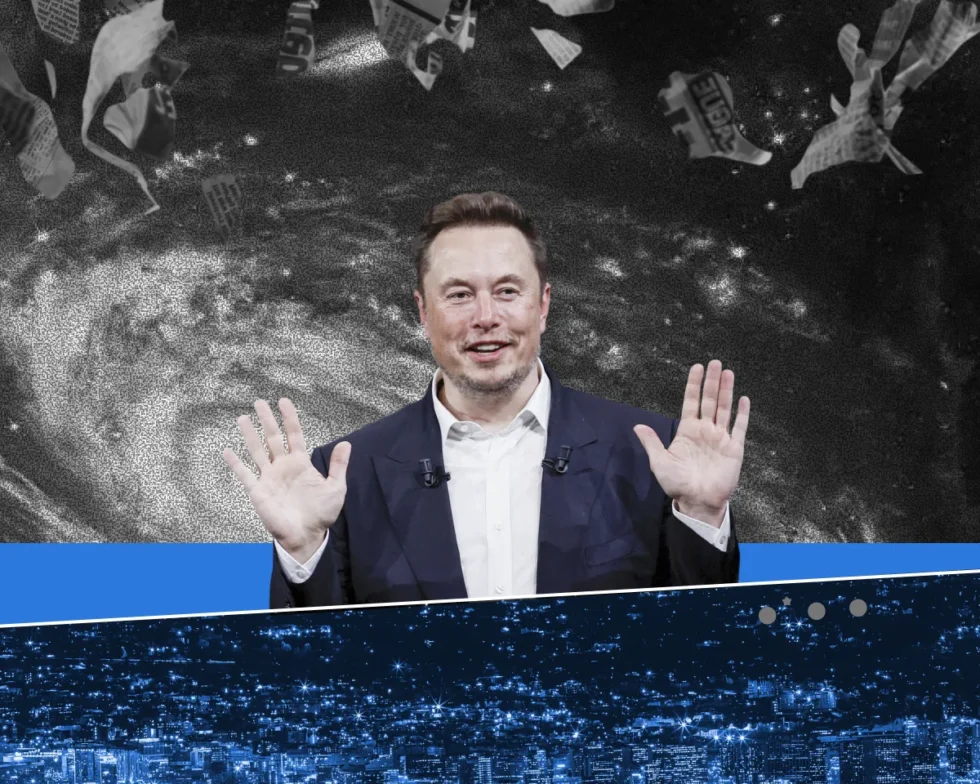
AI could surpass the collective intelligence of humanity in about five years, and humans are unlikely to maintain control over the technology within the next decade, according to xAI founder Elon Musk in an interview with The Economist’s editor-in-chief, Zanny Minton Beddoes.
Musk stated that artificial intelligence will eventually be able to perform almost all intellectual tasks better than humans.
“There will actually be nothing that AI can’t do better than humans, except perhaps being human,” he said.
Musk described the most likely scenario as an “era of abundance,” where people could obtain virtually any goods and services thanks to AI and robots. He linked this forecast to the year 2036 but emphasized that risks remain.
Mutual Model Checks
Musk said he does not see a realistic way to stop the development of AI and robotics. According to him, even if there were a “stop button,” it might not be worth pressing, as he considers “abundance for all” the most likely outcome.
However, the xAI founder acknowledged that the risk of a catastrophic scenario is not zero. He previously estimated the likelihood of humanity’s demise due to AI and robots at 10–20% and suggested that people might need to find new ways to give their lives meaning.
Instead of attempting to slow down development, Musk proposed that leading AI companies regularly discuss safety risks and provide competitors with limited access to new advanced models before release. In his view, competing labs could identify dangerous capabilities of models before public launch. If a company fails to address serious risks, authorities should intervene, Musk said.
Previously, Google DeepMind’s head Demis Hassabis proposed a similar initiative.
Criticism of OpenAI
In the same interview, Musk criticized Sam Altman and the transformation of OpenAI from a non-profit organization into a company with a commercial structure. According to Musk, the project was created as an open AI company “for the world,” but ultimately became a closed business.
Musk spoke more favorably of Anthropic’s head Dario Amodei, calling him a “principled person,” but noted that even competing AI companies should collaborate on safety issues.
In May, a federal court in Oakland dismissed Musk’s lawsuit against Sam Altman, Greg Brockman, OpenAI, and Microsoft due to late filing. Musk claimed that OpenAI deviated from its original non-profit mission, but the jury sided with the defendants on the statute of limitations issue.
In September 2025, Eliezer Yudkowsky, founder of the Machine Intelligence Research Institute, outlined the risks of superintelligent AI. Ethereum co-founder Vitalik Buterin believes such technology could be a catastrophe.
Earlier, Near Protocol co-founder Ilya Polosukhin noted that AI lacks economic incentives to destroy humanity.