




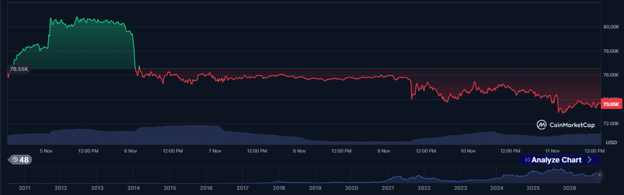
- Bitcoin fell below US$74K to US$73,657 as market sentiment deteriorated, with the Fear and Greed Index dropping to 26.
- Higher-than-expected US inflation and the possibility of a December Federal Reserve rate hike added pressure, alongside AI bubble concerns and Middle East tensions.
- US spot Bitcoin ETFs extended their outflow streak to four consecutive trading days, with November withdrawals reaching approximately US$1.58 billion.
- Analysts identified US$73K as a critical support level, warning that a sustained break could push Bitcoin towards US$69K, while a recovery could target US$78K.
Following a short rally post-election – the US midterms brought a sweeping win for the Democrats – Bitcoin crashed from the US$80K (AU$116.3K) mark down to around US$76K (AU$110.5K) in the middle of last week, only to drop another 3% since then. At the time of writing, BTC trades for US$73,657 (AU$107,105), establishing itself below the US$74K (AU$107.6K) mark.
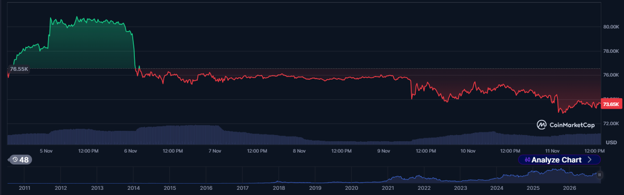
With that, fear is back in the crypto market: the Fear and Greed Index dropped to 26 (fear), inching closer to extreme fear, levels not seen since July.
Ethereum is also down over 8% on the weekly chart to US$2,060 (AU$2,995), while XRP fell by 15.8% to US$1.05 (AU$1.52). Solana is also down by 8%, currently trading at US$83.30 (AU$121.13).
More Turbulence Ahead
The market turbulence comes as inflation fears solidify. After a higher-than-expected Consumer Price Index (CPI) print for October, a US Fed rate hike before the end of 2026 is now quite likely.
Economists had expected a 0.3% CPI increase, but prices actually rose by 0.4%, according to Tuesday’s data from the Bureau of Labor Statistics.
Fed Governor Christopher Waller said that a 0.25% rate increase could come in December. He made the comments before the numbers for October had been released. During a speech at the Bank of England Watchers Conference in London, he added, “if inflation comes in substantially higher than I expect, more robust action by the FOMC may be called for.”
Worries around an AI bubble and ongoing tensions in the Middle East are also stoking fear.
Meanwhile, US spot Bitcoin ETFs have continued to see withdrawals. The funds recorded another US$95 million (AU$138.2 million) in net outflows on Tuesday, extending their outflow streak to four consecutive trading days. This follows US$201.08 million (AU$292.4 million) in withdrawals on Monday, bringing November’s total net outflows to around US$1.58 billion (AU$2.3 billion).
Read also: Elizabeth Warren Targets Prediction Markets and Trump Family Crypto Ventures
When Bottom?
Analyst VirtualBacon said on X that if Bitcoin closes “meaningfully below 73K”, he’d call it quits. He then believes we could see a low at US$68K to US$69K (around AU$98.9K to AU$100.3K) “as the absolute bottom”.
Matt Mena, senior crypto research strategist at 21Shares, also sees US$73K (AU$106.1K) as an important level. He believes a sustained break below it could push Bitcoin towards US$69K. However, if Bitcoin holds that level and equity markets recover, Mena sees a possible rebound towards US$78K (AU$113.4K), with US$85K (AU$123.6K) potentially within reach by the end of the year.
Read more: NYSE Picks Avalanche for Settlement in Planned 24/7 Tokenised Stock Market
The post Bitcoin Falls Below US$74K After Hot US Inflation Data, With US$70K in Sight appeared first on Crypto News Australia.