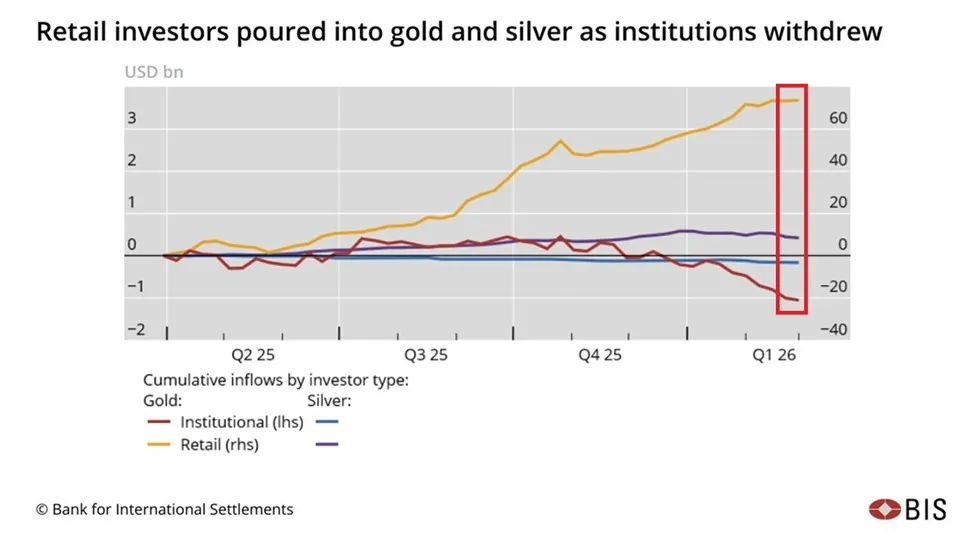
While institutional players were exiting gold, retail investors were purchasing it through ETFs in record volumes. This data was provided by analysts at The Kobeissi Letter, citing the BIS.
Wall Street is selling gold and silver to retail investors:
Since Q2 2025, retail investors have bought +$70 billion in gold ETFs.
These purchases have more than TRIPLED over the last 6 months.
Over the same period, institutional investors have sold -$1 billion with outflows… pic.twitter.com/l5epC5Q5aD
— The Kobeissi Letter (@KobeissiLetter) March 19, 2026
In the second half of 2025 and the first quarter of 2026, private capital invested approximately $70 billion in gold exchange-traded funds. Over the past six months, the pace of inflows has tripled, with the accumulated volume rising from $20 billion to $60 billion.
“Retail investors are fully focused on precious metals,” experts noted.
Institutional sales began in mid-November and accelerated sharply after the January correction in the precious metals market. Since then, gold has fallen by 9%, and silver has lost 34%.
The BIS explained the collapse as a result of overheated positions. Small speculators accumulated an excessive volume of leveraged longs. The subsequent margin calls and liquidations of over-leveraged funds triggered a domino effect.
“The reversal is not related to fundamental changes. It’s a story about retail flows and a chain reaction of forced sales,” specialists emphasized.
They concluded that the decline in gold and silver prices occurred amid changing expectations regarding U.S. monetary policy and the dynamics of the dollar, which strengthened by 4.7% since the end of January.
“The collapse in precious metal prices apparently coincided with a shift in expectations regarding the U.S. national currency and the direction of the Fed, but it was difficult to reconcile with broader changes in fundamental factors,” the BIS concluded.
Against this macroeconomic backdrop, the capitalization of the crypto market has shrunk by approximately 43% from October highs. Retail traders’ interest in digital assets has nearly dried up, settling at bearish phase levels.
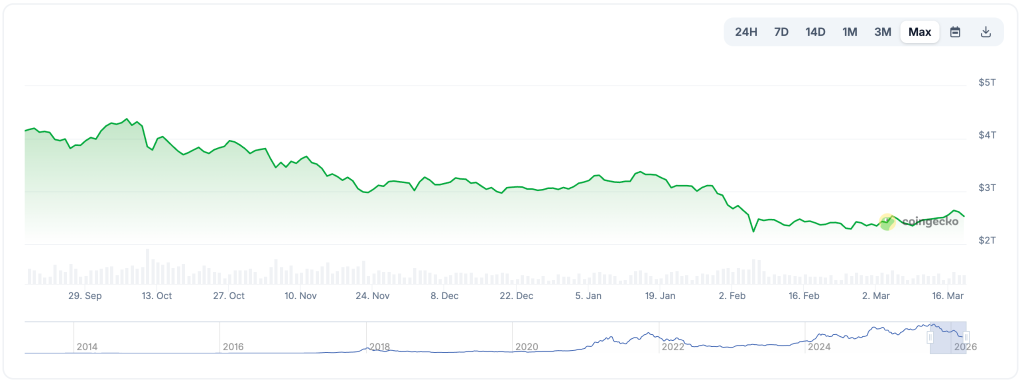
Earlier, on March 18, the Fed kept the key rate in the range of 3.5-3.75%. The price of Bitcoin fell below $70,000.