

The leading cryptocurrency lost 0.3% over the day, trading at around $66,666. Asian stock indices fell, while oil prices surged amid macroeconomic uncertainty.
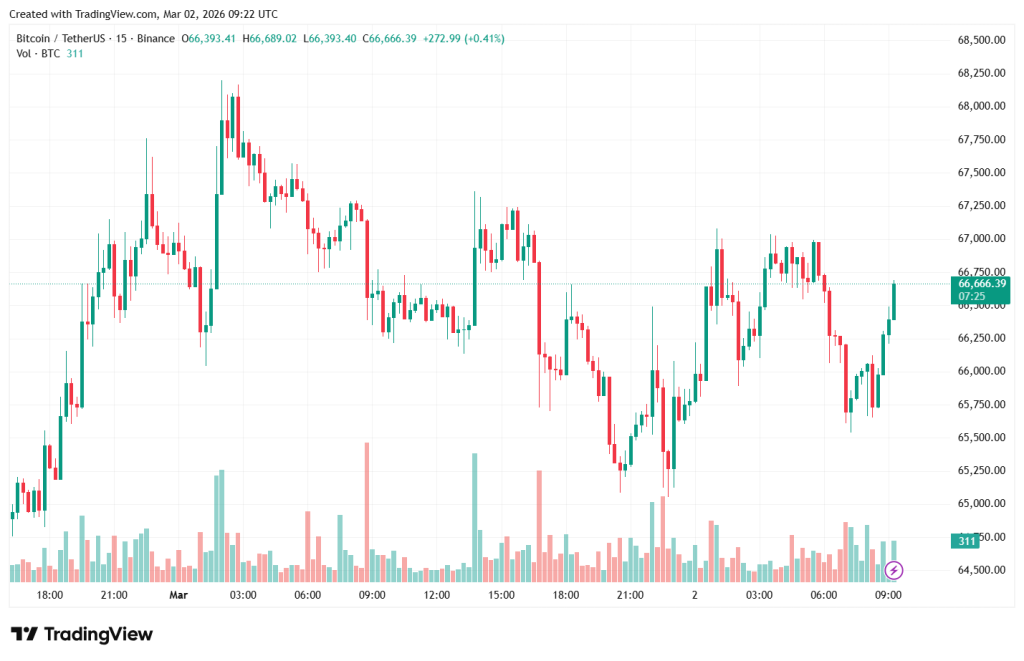
Over the weekend, Bitcoin’s price fluctuated between $63,000 and $66,000. Analysts noted the segment’s resilience: the 24/7 trading nature allowed investors to manage risks promptly while traditional markets were closed.
Dominic John from Kronos Research emphasized that cryptocurrencies quickly regained positions after local dips. CoinEx’s chief analyst Jeff Ko added that Bitcoin remained around $66,000 even amid stock sell-offs in Asia. He believes the market viewed the price surge as a temporary phenomenon rather than a signal for a prolonged decline.
Macroeconomic Pressure: Indices and Oil
Traditional markets opened in the red after the weekend. Japan’s Nikkei 225 index lost about 2.5%, while the broader Topix fell nearly 3%. Hong Kong’s Hang Seng and Singapore’s Straits Times dropped by approximately 2%.
Meanwhile, Brent crude rose by more than 8.38% to $78.9 per barrel. Gold increased by 2.05% to $5386.
Presto Research’s Rick Maeda identified oil as a key conduit of macro shocks for the crypto industry. In his view, if the price per barrel stabilizes above $90, it will heighten inflation expectations and strengthen the dollar. This would reduce liquidity, causing cryptocurrencies to react more sharply.
The market avoided cascading liquidations and destabilization of stablecoins. The uninterrupted operation of futures platforms like Hyperliquid helped the market absorb the shock in real-time.
Traders will continue to monitor oil prices, U.S. Treasury yields, and inflation.
Whether the volatility increase is temporary or markets face long-term liquidity tightening will become clear soon.
Crypto Market Resilience
Analysts at QCP Capital noted the return of crypto market quotes to previous levels. Due to sharp price swings, algorithms liquidated long positions worth about $300 million. Experts described the volume of closures as moderate compared to the large-scale deleveraging in early February.
The low liquidation figures indicate that traders had preemptively reduced risks. Bitcoin’s role as a “weekend hedge” is gradually shifting to tokenized gold. It also trades 24/7 and attracts capital during periods of instability.
Derivative metrics also confirm market stability. A brief spike in expected volatility to 93% was lower than last week’s values at similar price levels.
Market participants were prepared for sharp movements, according to QCP. Analysts saw signs of a repeat of last June’s scenario: Bitcoin fell below $100,000 over the weekend, recovered on Monday, and set a new high at $123,000 weeks later.
Expectations of Major Capital
Despite the local dip, major players are betting on long-term growth. Significant purchases of March call options were recorded on February 28:
- 1,000 contracts with a strike price of $74,000;
- 4,000 contracts with a strike price of $75,000 (expiration — March 27).
Such transactions confirm traders’ expectations of a spring rebound after five months of decline.
Despite positive market signals, QCP experts recommend caution: further price movements will depend on geopolitical conditions and the macroeconomic backdrop.
A Buying Signal
Most investors who bought Bitcoin in the last two years are currently at a loss. According to analyst Crypto Dan, further price declines could present a good market entry opportunity.
Most Investors Who Bought Within the Last 2 Years Are in Loss
“If Bitcoin’s price drops below $60,000, putting the majority of investors (excluding very long-term holders) into loss territory.” – By @DanCoinInvestor pic.twitter.com/3srPTeNcnT
— CryptoQuant.com (@cryptoquant_com) March 2, 2026
He argues that “reverse logic” often works in investment markets. Sharp crashes occur when the majority earns windfall profits. Conversely, strong rallies begin after most investors face significant losses.
The analyst believes that a drop in digital gold below $60,000 will increase the share of losing positions. Almost everyone, except long-term holders, will be at a loss. According to the expert, this moment will be optimal for aggressive buying.
Crypto Dan also noted that the absence of a clear strategy often leads to doubts when opening or closing trades. In the current market conditions, he advises investors to predefine specific trading criteria.
Back on March 1, analyst CryptoTalisman stated that the leading cryptocurrency had fully recovered from the decline amid geopolitical tensions and macroeconomic instability.