

The MPI metric has fallen to -1.04, marking the third lowest level in history. This was highlighted by CryptoQuant analyst Ignacio Moreno de Vicente, who described the development as a bullish signal.
Extreme Miner Inactivity: A Hidden Strength or Silent Warning?
“Historically, the signal becomes more actionable when MPI begins to rise from these lows, indicating re-engagement alongside improving market conditions.” – By @MorenoDV_ pic.twitter.com/Few2hTlmgz
— CryptoQuant.com (@cryptoquant_com) March 23, 2026
Such levels indicate that miners of the leading cryptocurrency are sending fewer coins to exchanges than usual, compared to the annual average. The selling pressure from them is structurally reduced.
According to the expert, an extremely low MPI is a positive signal: the market sees a reduction in supply from some of the most consistent and natural sellers.
In past cycles, similar values were observed during periods of miner stress or post-capitulation phases—often against a backdrop of macroeconomic uncertainty and margin compression. However, the reduction in selling pressure does not serve as a reliable indicator of an absolute price bottom, Moreno de Vicente emphasized.
“MPI reflects the relative behavior of sellers, but does not show who is absorbing the supply. Without a clear expansion of demand (spot flows, inflows into ETFs or positioning in derivatives), a low MPI alone cannot ensure a sustainable upward movement,” he added.
The signal becomes stronger when the indicator starts to rise from its lows. This indicates a return of activity as market conditions improve.
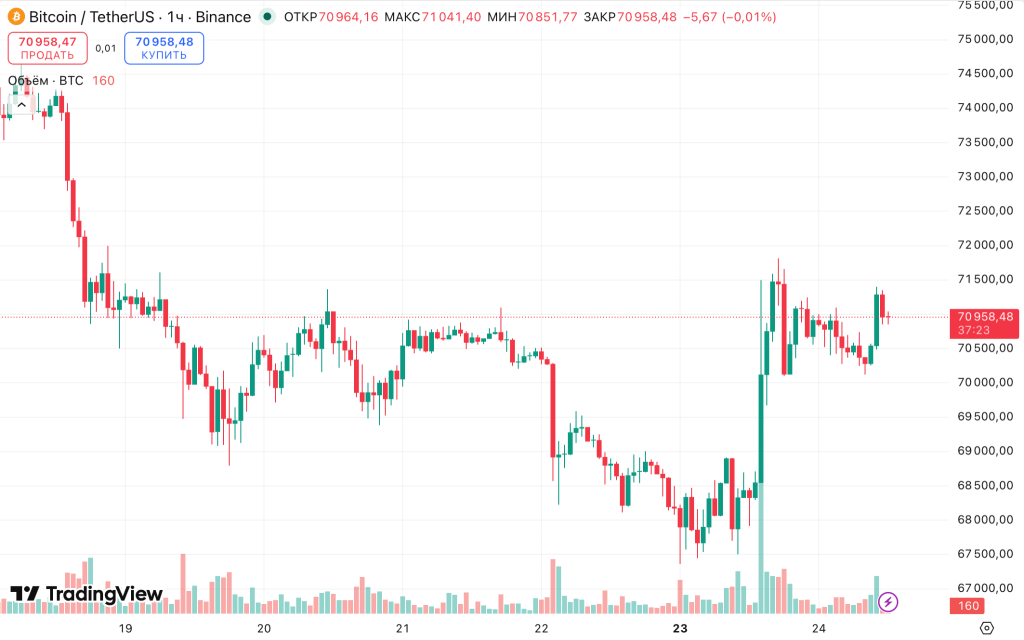
At the time of writing, Bitcoin is trading around $71,000. Over the past 24 hours, the asset’s price has increased by 3.9%.
Rare Blockchain Reorganization
The concentration of Bitcoin miners led to a rare event—a network reorganization. At the center was the largest pool, Foundry USA, which combines computing power to verify transactions and mine blocks.
We just had a rare-ish two block fork/reorg between Foundry and AntPool+ViaBTC. Foundry mined six blocks in a row.https://t.co/qpj7eLlh0U pic.twitter.com/Jd5m1LX036
— b10c (@0xB10C) March 23, 2026
On March 23, Foundry and AntPool discovered blocks almost simultaneously, temporarily splitting the chain. Foundry outpaced its rivals by mining several in a row, making its version the main one. The blocks from AntPool and ViaBTC became “orphaned”: they were excluded from the registry, leaving miners without a reward.
At height 941,881, both pools found valid blocks within a 12-second interval (15:49:35 and 15:49:47 UTC). The network diverged: some nodes accepted one branch, others the other. At the next height, ViaBTC continued AntPool’s chain, while Foundry continued its own, creating two competing lines two blocks deep.
Then Foundry took the next heights (941,883 and 941,886), giving its version a decisive advantage in terms of work invested. Transactions from the “orphaned blocks” were not lost; they returned to the mempool.
A two-block reorganization does not threaten Bitcoin’s security—the network functioned as expected, choosing the longer chain and restoring consensus within minutes.
However, the incident highlighted the risks of concentration: the fewer pools control the hashrate, the higher the likelihood that one of them will mine several blocks in a row, increasing the chance of competing chains emerging when large players mine simultaneously.
On March 21, mining difficulty decreased by 7.76%—the second largest negative change in 2026. The hashrate fell from a record 1 ZH/s to about 920 EH/s.
Small and medium miners are leaving the market: with Bitcoin priced at $70,000, mining becomes unprofitable. The estimated cost is $88,000. Each exit concentrates the remaining hashrate in fewer pools, exacerbating the problem.
Earlier in March, the volume of yet-to-be-issued coins of the first cryptocurrency reached 1 million. The remaining bitcoins will be mined by 2140.