






In 2026, the price of the leading cryptocurrency could plummet to $10,000, heralding a recession in the US economy, according to Mike McGlone, a senior commodity strategist.
Collapsing Bitcoin/Cryptos May Guide the Next Recession —
“Healthy Correction” is what we should hear soon from stock market analysts (who risk unemployment if not onboard), following collapsing cryptos. The buy the dips mantra since 2008 may be over, here’s why:
— US stock… pic.twitter.com/fPPc2fV3EU
— Mike McGlone (@mikemcglone11) February 15, 2026
“We should soon hear from stock market analysts (who risk losing their jobs if they don’t support this) about a healthy correction following the collapse of cryptocurrencies. The ‘buy the dips’ mantra that has been in place since 2008 may no longer be relevant,” the expert wrote.
He cited several factors reflecting an elevated level of risk:
- The ratio of stock market capitalization to US GDP is at a century-high peak;
- The 180-day volatility of key indices S&P 500 and Nasdaq 100 is at its lowest in the past eight years;
- Euphoria regarding Donald Trump’s crypto policy is waning — “the bubble is bursting”;
- Gold and silver are rising at a pace last seen about half a century ago, and a spike in their volatility could impact other markets.
McGlone presented a chart comparing the dynamics of the S&P 500 and the price of Bitcoin (divided by 10). Both indicators fluctuate below 7,000 points. In his view, the cryptocurrency, heavily reliant on beta coefficient, is unlikely to hold at this level when the metric weakens for stocks.
The analyst set 5,600 as the target for an “initial normal return” of the index. For Bitcoin, this translates to $56,000.
Further, according to his base scenario, the digital asset could retreat to the $10,000 mark depending on the peak of the US stock market.
In December, McGlone first warned that Bitcoin might fall to this level. At that time, the quotes were above $86,000. The expert noted that a likely crash of high-risk assets like cryptocurrencies would trigger an economic recession in the United States.
In early February, McGlone reiterated his forecast. Bitcoin was already trading near $79,000 and subsequently fell below this mark.
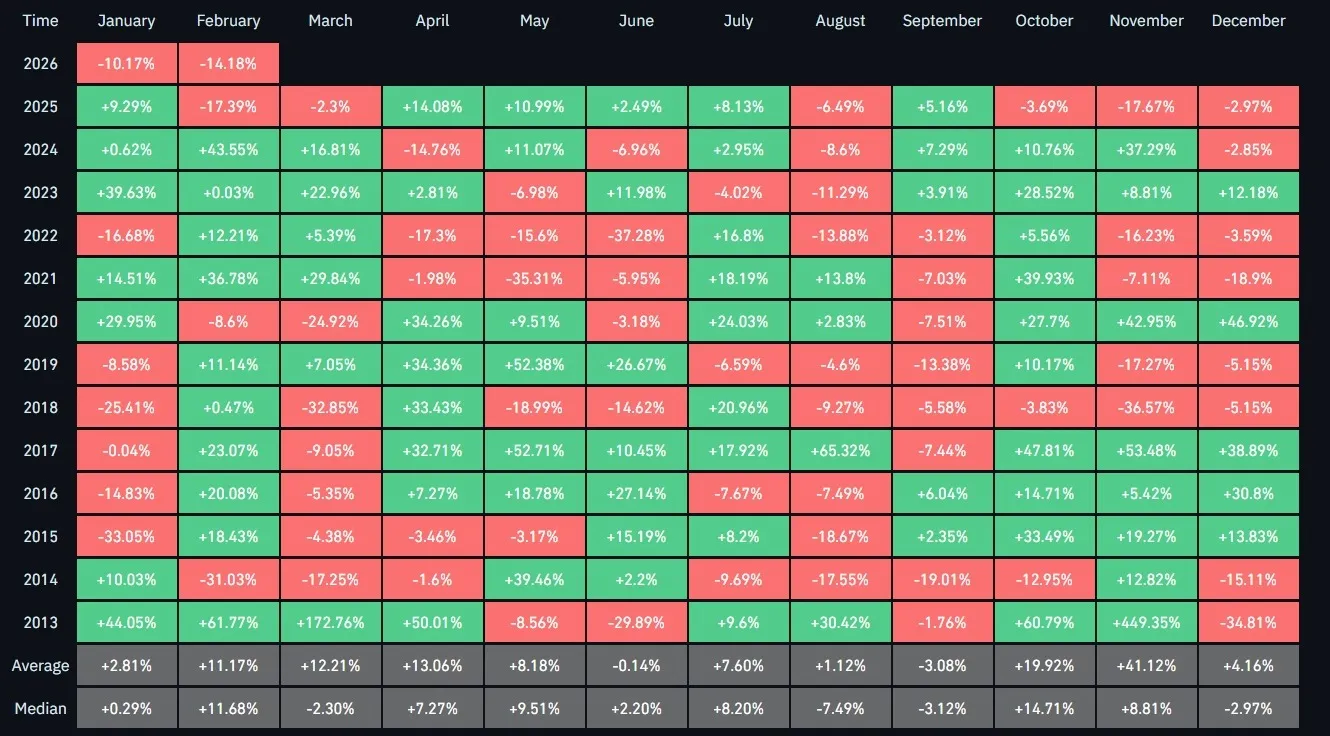
Digital gold has depreciated by nearly 23% since the beginning of the year. February, with a current figure of -14%, could become the fifth consecutive month of cryptocurrency decline.
McGlone’s Scenario Questioned
AdLunam co-founder and market analyst Jason Fernandes, in a comment for CoinDesk, noted that the Bloomberg Intelligence strategist’s thesis suggests:
- Market extremes must resolve through a general collapse;
- Bitcoin’s beta coefficient guarantees a proportional crash.
“This is a false comparison and a bias oriented towards a single development path. Markets can also eliminate excess over time through rotation or inflation reduction,” the expert stated.
According to Fernandes, a slowdown at the macroeconomic level could lead to consolidation or restructuring of cryptocurrency in the $40,000-50,000 range.
A plunge to $10,000 would likely require a “truly systemic event” that leads to a sharp liquidity contraction, widening credit spreads, forced fund deleveraging, and an uncontrolled stock collapse.
“This implies a recession plus financial stress, not just a growth slowdown. In the absence of a credit shock or policy mistake that depletes global liquidity, such a collapse remains an unlikely risk factor,” he emphasized.
Earlier, K33 Research analysts suggested that Bitcoin’s drop on February 6 to $60,000 marked a local bottom before a consolidation phase. However, CryptoQuant questioned the end of the correction.
Standard Chartered allowed for a dip in digital gold to $50,000.