

Prediction platform Kalshi canceled a market related to Iran’s supreme leader, Ali Khamenei. CEO Tarek Mansour pledged to reimburse users, but many complained of losses.
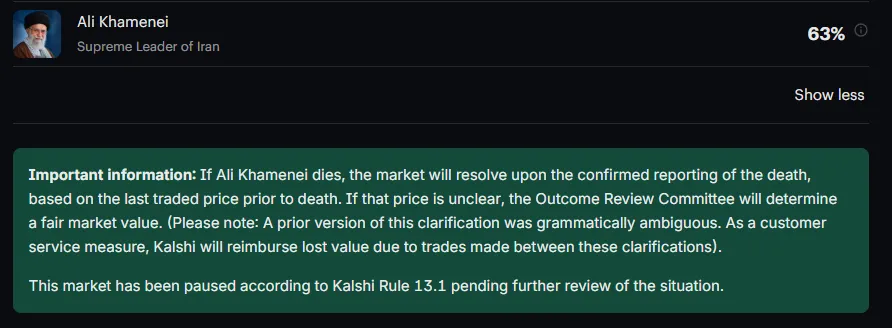
The market concerned the “removal” of politicians, but trading was frozen after reports of Khamenei’s death appeared. According to the platform, wagering in this category had been available since November 2025.
Mansour posted on X to explain the platform’s stance and the rules for rolling back trades.
On Khamenei:
We don’t list markets directly tied to death. When there are markets where potential outcomes involve death, we design the rules to prevent people from profiting from death. That is what we did here.
I know some of you disagree and prefer that we list these…
— Tarek Mansour (@mansourtarek_) March 1, 2026
“We do not list markets directly tied to death. Where there are markets whose potential outcomes involve death, we design the rules to prevent people from profiting from such outcomes. That is what we did here,” the Kalshi CEO said.
He said the market tied to the Iranian leader’s departure was “important” economically and politically, and that leaving office might not involve violent means. As an alternative example he cited Venezuela’s president, Nicolás Maduro.
“In such cases we clearly indicate this in the rules and on the market page, but today was a good lesson showing we can do more to improve the user experience and add new ways to display the rules. We are determined to improve,” Mansour added.
Under the compensation terms, the platform pledged to refund all fees, and positions opened before reports of Khamenei’s death would be rolled back at the last traded price.
“No user will lose a dollar on this market,” the Kalshi chief executive assured.
What went wrong
Despite Mansour’s statements, many users complained about losses on positions or incomplete compensation. A community note appeared under the CEO’s post on X.
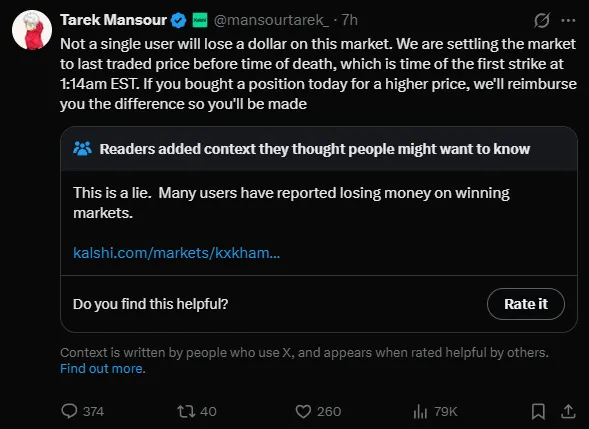
“This is false. Many users reported losing money on winning trades,” the note said.
A user going by Sameer posted a screenshot showing a winning position placed at a 6% probability being closed with $245 in compensation against an initial $1,034 outlay. Had the outcome been counted, the payout would have exceeded $12,000.
Deceiving your customers, then calling them “users” , and next lying on twitter is going to be fun in court @mansourtarek_ @Kalshi @CFTC @SECGov @RealBenGeller pic.twitter.com/FBeDlSxv2V
— Sameer (@sameeriously) March 1, 2026
“Deceiving your customers, calling them ‘users’, and then lying on social networks — it will be fun in court,” the user wrote.
Other Kalshi users reported similar situations, differing only in loss amounts and bet details.
Liar. You’re getting sued. pic.twitter.com/4VO5pEB0Bd
— Zander Pyle (@Alexander_333_) March 1, 2026
Representatives of the prediction platform have not yet published additional comments on the compensation issues.
One trader appealed to the SEC and the CFTC to investigate, saying that when the market was listed, the cancellation terms were not disclosed anywhere.
Countering the ethical rationale for closure, a user nicknamed jellyman recalled a market on whether the 39th U.S. president, Jimmy Carter, would attend Donald Trump’s inauguration.
“[You kept the market] even after his passing. You knew that people were betting on the death of a 99-year-old elderly man […]. You are fine with death, but not when it doesn’t make you money,” he wrote to Kalshi’s management.
Record volumes
According to defioasis, on the day of the strike on Iran, February 28th, Polymarket’s daily trading volume hit an all-time high of $478 million.
在美以对伊朗实施联合打击当天,Polymarket 单日交易量创下历史新高,名义交易量达到 4.78 亿美元
其中政治板块达 2.2 亿美元,同样创下历史新高,占比当日 Polymarket 名义交易量的 46.2%
此外,Polymarket Builders 在这历史节点上同样创下了单日交易量新高 pic.twitter.com/KnKmWO3vAn
— defioasis.eth (@defioasis) March 1, 2026
The politics category accounted for $220 million (46.2% of the total), also a record. Peak activity was likewise recorded in the Polymarket Builders automation ecosystem.
In parallel, Bubblemaps analysts identified six possible insider wallets that bet on a strike on Iran, earning more than $1.2 million in total.
JUST IN: 🇮🇷 🇺🇸 Six suspected insiders made $1.2M betting on a US strike on Iran
Most of these wallets:
• were funded in the last 24h
• specifically bet for February 28
• bought “yes” hours before the strike pic.twitter.com/n3G6OIEOXt— Bubblemaps (@bubblemaps) February 28, 2026
In February, Ethereum co-founder Vitalik Buterin expressed concern about the current state of prediction markets. In his view, growing reliance on uninformed speculators threatens the sector’s viability.