






OpenStar Technologies, a startup from Wellington, has claimed a breakthrough in sustained nuclear fusion, Bloomberg reports.
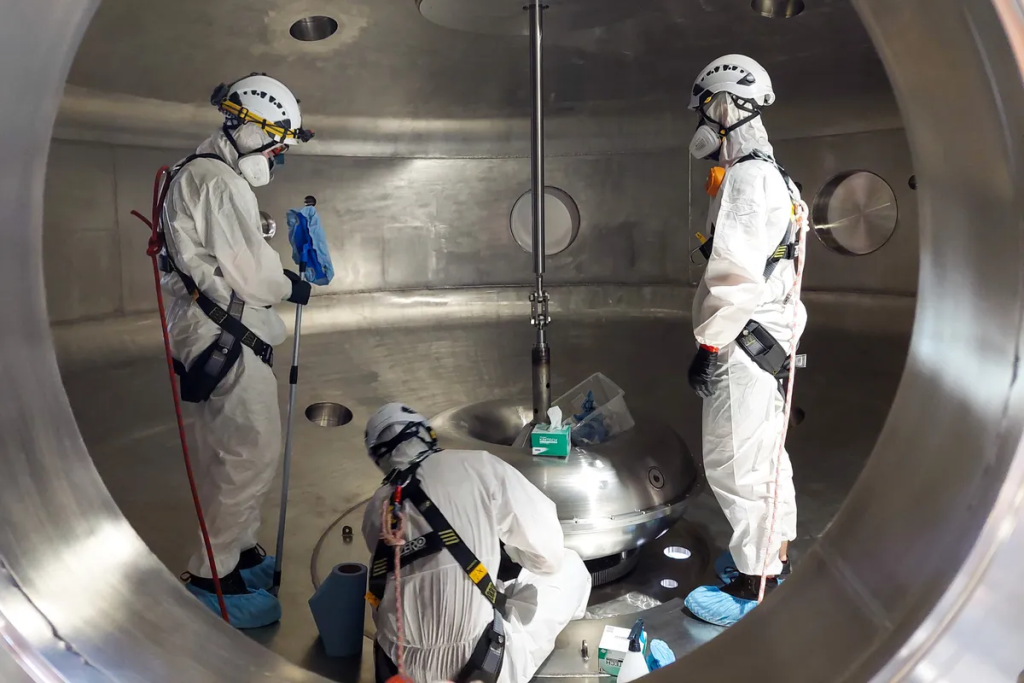
The team managed to levitate a 500kg magnet inside a five-metre vacuum chamber filled with a glowing gas heated to over a million degrees Celsius.
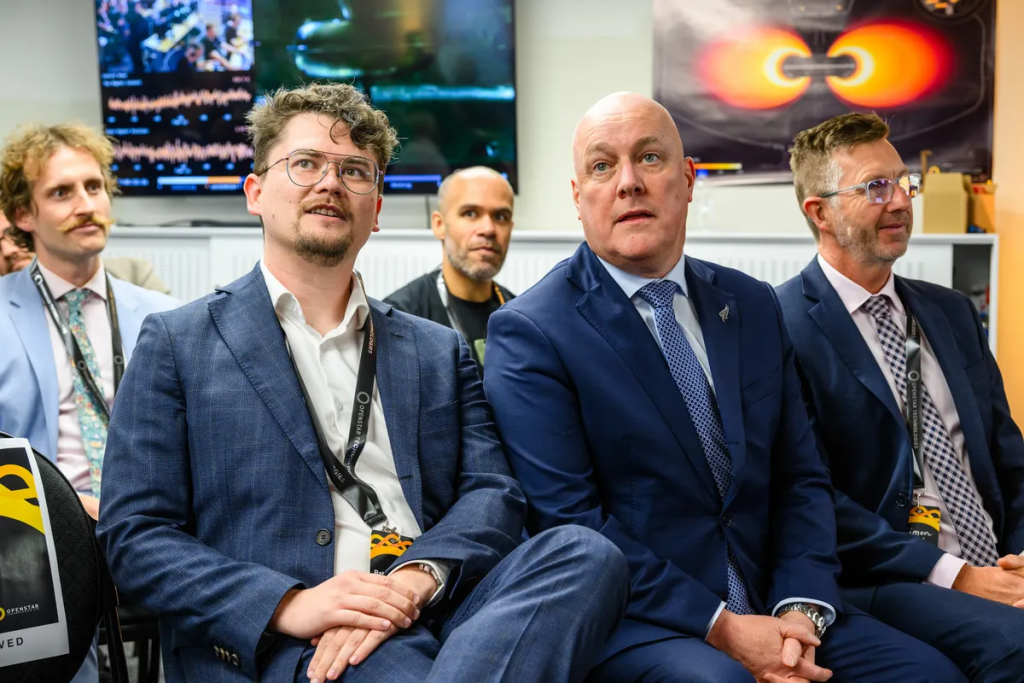
A select group watched the demonstration, including New Zealand’s prime minister, Christopher Luxon.
The reactor still consumes more energy than it produces. Even so, successful levitation is an early milestone indicating the technology’s viability.
OpenStar’s CEO and founder, Ratu Mataira, argues that the design’s simplicity gives the company an edge in building an efficient source of fusion power. He says levitating a superconducting magnet vindicates the approach and shows it can be scaled.
“No one yet has a working fusion system capable of producing economically viable electricity. Starting with a simpler set-up that can be scaled faster and made cheaper is an attractive approach,” the physicist said.
The race for nuclear fusion
Some 50 firms worldwide are vying to be first to fuse atomic nuclei to produce cheap energy. OpenStar has raised nearly $10bn from investors such as Bill Gates and Jeff Bezos.
“Fusion energy can revolutionise the energy sector by providing an unlimited source of safe and clean energy. After what we saw, it became clear that this prospect is closer to reality than ever before,” Luxon stressed.
Timelines remain uncertain—estimates range from 10 to 30 years.
Other countries have announced similar breakthroughs. In 2022, scientists in California for the first time extracted more energy from a fusion reaction than was required to initiate it.
OpenStar reckons several generations of prototypes will be needed before a system can power an entire neighbourhood.
How it works
Nuclear fusion requires plasma—the fourth state of matter (the other three are solid, liquid and gas). It is so hot that electrons are stripped from atoms, forming an ionised gas. Stars, lightning and auroras are forms of plasma.
In the Sun’s core, heat and gravity compress plasma and hold it at the centre. Under colossal pressure, atoms fuse, releasing the energy that powers the entire Solar System.
One way to reproduce this on Earth is to use magnetic fields to confine plasma and trigger fusion.
In the 1950s Soviet physicists developed the tokamak—a promising concept in controlled fusion. The doughnut-shaped reactor uses powerful magnets placed around the plasma chamber.
This architecture underpins the multi-billion-dollar International Thermonuclear Experimental Reactor in southern France. Its drawbacks are cost and the potential instability of plasma.
“A tokamak is more like a jet engine—in how it must be designed and how performance is extracted. It relies heavily on complex modelling and high-precision manufacturing. A dipole is more like a campfire. You roughly arrange the elements, add heat—and once the fire takes, it sustains itself,” Mataira explained.
In 1987 Japanese theoretical physicist and engineer Akira Hasegawa proposed an alternative: place a high-temperature superconducting magnet not outside the plasma but inside it. The scheme became known as the levitated dipole reactor.
In 2004 MIT and Columbia University successfully demonstrated the idea, but later halted research owing to funding shortages and the technology’s limits at the time.
OpenStar’s prospects
The company is preparing a new prototype called Tahi, slated for unveiling in two years. Within five years it expects a third-generation model (Maui) that will generate neutrons and be commercially viable.
The final stage will be a fourth-generation system, Tama Nui, with a projected output of 50–200MW—enough to power a small city or a large industrial site.
Why it matters
The rapid development of artificial intelligence is driving exponential growth in electricity consumption. Morgan Stanley has forecast a 36GW capacity shortfall in the United States over the next three years.
The strain is already reaching consumers: tariffs are rising and overloaded grids are causing outages. Since the launch of ChatGPT, electricity prices in America have risen by 23%. Since 2020 they are up 40%, outpacing overall inflation.
Analysts at The Kobeissi Letter see nuclear power as one potential remedy. Unlike solar and wind, nuclear plants operate around the clock, as required for uninterrupted AI workloads. It is also among the most economical sources of energy.
But building nuclear plants takes time. At present, not a single large reactor is under construction in the United States.
Fusion could address the electricity shortfall, says serial entrepreneur and Dataprana.io founder Sergey Grusha.
“Yes, in theory fusion is one of the most ‘ideal’ sources for training artificial intelligence and mining: stable baseload generation 24/7, high energy density, minimal emissions and predictable power (like nuclear energy),” he said in a comment to ForkLog.
The expert noted that rising energy demand will only intensify over time.
“There will only be growth: we estimate an increase in AI capacity of about 75GW by 2030—fivefold. For comparison, Germany consumes 55GW today. Plus we will need to support electric cars and robots. Global consumption will double over the next ten years,” Grusha noted.
Despite its appeal, he said, fusion will not be a solution in the coming years—it remains an early-stage technology.
“Even classical nuclear generation is built over decades. My realistic forecast for mass fusion deployment for data centres is about 15–25 years. Therefore, over the next 5–10 years the growth of AI/HPC will be covered by gas, existing nuclear power, RES and storage,” Grusha said.
He added that grid infrastructure—substations, transformers and interconnection capacity—has become the main bottleneck.
Is space the answer?
Some entrepreneurs think the future of data centres lies beyond Earth, arguing that the planet’s power grids are approaching their limits.
In January Elon Musk said that Tesla would resume work on Dojo3—a previously abandoned project to build a third-generation chip for electric vehicles. Its new purpose is space-based computing.
The advantages include virtually unlimited access to solar energy and room to house equipment. The drawback is the high cost of launching rockets with the necessary infrastructure. Even so, analysts at 33FG estimated that AI computing in orbit will become economically viable by 2030.
Google was among the first to move. The firm announced a plan to build a network of near-Earth satellites to power data centres. OpenAI CEO Sam Altman supports the idea, but Musk has a strategic advantage—control over launch capacity.
With the forthcoming IPO of SpaceX, he aims to finance a constellation of compute satellites launched by Starship rockets. In orbit, the machines could harvest solar energy around the clock thanks to constant illumination.
In January, Alibaba Cloud’s Qwen-3 became the world’s first AI model to be uploaded and to operate in orbit.