
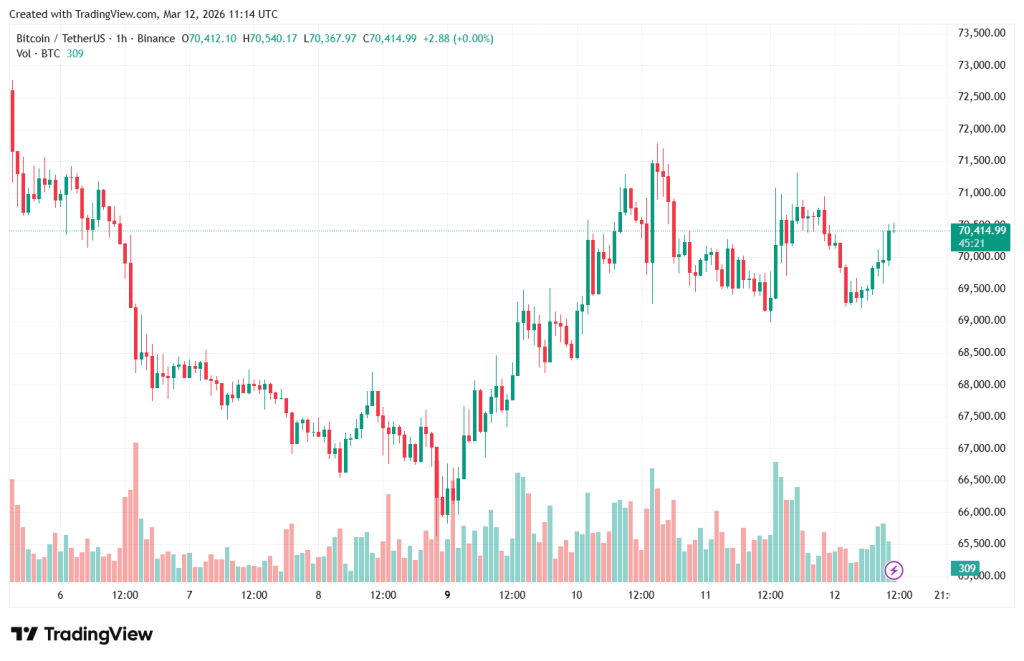
Bitcoin has steadied around $70,000 after a bout of volatility. Despite macroeconomic headwinds, options markets are positioning for a continued rally, eyeing $80,000 by early summer.
Sentiment was supported by fresh data on US inflation that matched analysts’ expectations. The core consumer price index held at 2.4% year on year. Investors typically read such predictability as a positive signal.
Even so, analysts urge caution: the latest reports do not yet reflect the recent jump in oil prices. That leaves the Federal Reserve in a bind ahead of its meeting on 18 March. Inflation has formally eased and the labour market has cooled, but instability in energy could spark a renewed bout of price growth.
Bitcoin’s resilience
Analysts at QCP Capital noted that the asset weathered market turmoil with poise. After a brief dip below $63,000 amid panic selling, it quickly reclaimed the psychological $70,000 level. Long-term investors continue to accumulate coins in the $60,000–$70,000 range, providing a stabilising base.
Derive.xyz founder Nick Forster said the options landscape has shifted. Traders have softened their hedges: skew has flipped from negative to positive, and put-selling volumes have risen. That pattern implies expectations of steady or rising prices.
Derive estimates a 35% chance that bitcoin rises above $80,000 by the end of June. Many traders reckon the worst of the drawdown is over.
Big bearish wagers
Bearish positioning remains sizable. An on-chain options trade worth $130m was recorded, targeting a move to $65,000 by the end of March. That suggests large capital is still hedging against macro uncertainty.
Stefan Koltman, head of macro at 21Shares, warned that an uptick in inflation next month is all but inevitable amid energy shocks. The key variable for markets will be the Fed’s response to the new readings.
XS.com analyst Rania Gule said bitcoin held its ground while US equities and gold came under pressure. The cryptocurrency is correlating less with stocks, taking on the traits of a hybrid financial instrument.
The market is calmer than a week ago, but remains fragile. The next leg will hinge on macro data and the Fed’s decision.
Signs of stabilisation
For nearly a month bitcoin has traded in a tight $62,800–72,600 range. Attempts to hold above $70,000 have faltered amid geopolitical uncertainty. Yet Glassnode analysts flag a notable shift: the market is transitioning from forced deleveraging to a period of stabilisation.
The price is boxed in between two historical levels:
- support: realised price ($54,400) — the average purchase cost of all coins in circulation;
- resistance: true mean market price ($78,400).
An accumulation cluster is forming in the middle of this channel. Investors are adding gradually, but current volumes are not yet sufficient to power a strong breakout.
Short-term holders remain under pressure. The STH-SOPR stands at 0.985: readings below one indicate recent buyers are realising losses.
This pattern is typical of bearish phases. On bounces, the metric creates a “ceiling”: investors seek to sell at breakeven, capping rallies.
ETFs and spot demand
After several weeks of outflows during the correction, inflows have begun to recover. The seven-day moving average of inflows into US spot bitcoin-ETFs has turned positive. Institutional investors are buying the dip.
There are signs of life on spot exchanges too. The cumulative volume delta (CVD) has turned higher — buyers are absorbing sell-side liquidity on major venues. For a durable advance, that trend needs to persist.
When a short squeeze
In perpetual futures, funding rates have flipped negative. That points to bearish positioning: most traders are short and paying to hold those bets.
Experts warn that if spot demand keeps firming, the build-up of shorts could trigger a short squeeze and a sharp price jump.
Tension in the options market is easing as well:
- short-dated implied volatility is falling — traders are trimming hedges;
- puts still trade richer than calls, but the gap is narrowing quickly;
- flow is rotating into calls — over the past 24 hours they accounted for 40.3% of total volume.
Key levels
At current prices the spot market remains neutral. The hedging activity of market makers may keep bitcoin in a $67,000–71,000 corridor.
The main magnet sits higher: around $75,000 there is roughly $2bn of negative gamma. If prices reach that zone, market makers’ buying could spark an impulse toward $80,000. Glassnode noted that $1.8bn of that options exposure expires on 27 March, after which market dynamics may shift.
In sum, bitcoin remains under pressure, but rising ETF inflows, a recovery in spot buying and crowded shorts lay the groundwork for a potential rebound.
Futures trading volume
On Binance, the futures-to-spot volume ratio has risen to 5.1. According to CryptoQuant analyst maartunn, this is the highest reading since mid-2023.
Binance Futures/Spot Ratio Hits 1.5-Year High
“It reflects structural growth in derivatives trading, with futures volume expanding significantly while spot volume has remained largely flat.” – By @JA_Maartun pic.twitter.com/WX6Lqk90UG
— CryptoQuant.com (@cryptoquant_com) March 12, 2026
The current reading implies derivatives turnover is more than five times spot.
By the analyst’s tally, total volumes on the platform in 2025 reached $32.39trn, of which:
- derivatives — $25.4trn;
- spot — $6.99trn.
Year on year, futures volumes rose 19.7% from $21.21trn in 2024, while spot showed little change. To maartunn, this points to a structural shift: derivatives trading is expanding as spot demand remains steady.
Derivatives market
According to Deribit data, open interest in $20,000 strike puts has neared $800m, the fourth most popular bearish wager. Sidra Farik, head of retail sales at Deribit, noted these figures should not be read as a crash call.
She said traders are selling “deep out-of-the-money” options to earn premium. The probability of a plunge to that level is viewed by market participants as extremely low.
Broader market
Despite oil nearing $100 a barrel, crypto markets remain resilient. Bitcoin, Ethereum, XRP and Solana are trading without sharp swings. One outlier is HYPE, the token of Hyperliquid, which gained about 7% over the day.
Analysts argue the current consolidation is flushing out excess leverage.
“Reducing the share of leveraged positions creates a more stable foundation for the next move, when a clear macro driver appears,” explained Diana Pires, vice president of sFOX.
External risks nonetheless persist. The MOVE index, which tracks US Treasury volatility, has climbed from 60 to 76 since late February. Such a move threatens further tightening in global financial conditions, which has historically weighed on risk assets.
In March, Bloomberg Intelligence senior strategist Mike McGlone reaffirmed his forecast that the price of the first cryptocurrency could still plunge to $10,000.