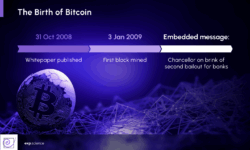
Every revolutionary journey has a beginning, and for Bitcoin, that beginning is the Genesis Block. Also known as Block 0, this foundational block was mined by the mysterious Satoshi Nakamoto on January 3, 2009, marking the birth of the world’s first decentralized cryptocurrency. Understanding the Genesis Block is essential not only for appreciating Bitcoin’s technical brilliance but also for grasping the ideological and historical significance behind the digital currency that has reshaped global finance.
What Is the Genesis Block?
In blockchain terminology, a “block” is a package of transactions recorded on a ledger. The Genesis Block is the very first block of Bitcoin’s blockchain, serving as the foundation upon which all subsequent blocks and transactions are built. Unlike later blocks, the Genesis Block is unique: it was hard-coded into the Bitcoin software by Satoshi Nakamoto and contains a symbolic message that provides insight into the motivations behind Bitcoin’s creation.
Embedded in the block’s coinbase parameter—the field that usually holds arbitrary data—was a headline from the UK’s The Times newspaper:
“The Times 03/Jan/2009 Chancellor on brink of second bailout for banks.”
This message is more than a timestamp; it is a political and philosophical statement. Bitcoin, from its inception, was designed as a response to the centralized banking system and the 2008 financial crisis, offering an alternative that is transparent, decentralized, and resistant to manipulation.
Technical Features of the Genesis Block
The Genesis Block contains 50 BTC, which cannot be spent due to a quirk in the original code—making it unique in Bitcoin’s history. This block established the proof-of-work consensus mechanism, linking it to subsequent blocks through cryptographic hashing, forming the immutable chain that defines Bitcoin’s ledger.
Some key features of the Genesis Block include:
- Cryptographic Security: Every block in Bitcoin’s blockchain, starting with the Genesis Block, is secured using the SHA-256 hashing algorithm, ensuring integrity and immutability.
- Proof-of-Work: Mining the Genesis Block required computational effort, demonstrating the concept of proof-of-work that protects the network from double-spending and manipulation.
- Immutable Foundation: Being the first block, it serves as the anchor for the entire blockchain, meaning every transaction ever processed in Bitcoin can ultimately be traced back to this origin.
The Ideological Significance
The Genesis Block is more than a technical artifact; it is a manifesto. The embedded headline highlighted the instability and failings of traditional financial systems, signaling that Bitcoin was created as a hedge against centralized control. Satoshi’s vision was not just about creating a new form of money—it was about empowering individuals, creating trustless systems, and challenging the status quo of finance.
The Early Days of Bitcoin Mining
During the Satoshi Era, mining was a decentralized and community-driven activity. Unlike today, where industrial-scale mining farms dominate the network, early miners used personal computers to validate transactions and secure the blockchain. Mining the Genesis Block and early subsequent blocks allowed pioneers to accumulate Bitcoin with relatively little computational power, laying the foundation for what would later become a global ecosystem.
This period also demonstrated the principles of scarcity and incentive alignment. With a capped supply of 21 million coins and block rewards that halve approximately every four years, Bitcoin’s design ensured that miners were incentivized to maintain network integrity while gradually limiting the creation of new coins.
Legacy of the Genesis Block
The Genesis Block represents the starting point of a financial revolution. Its creation validated a new way of thinking about money—one that is decentralized, transparent, and secure. Today, billions of dollars in value are secured by the blockchain architecture that traces back to this first block.
For developers, the Genesis Block is a blueprint of innovation. It exemplifies how thoughtful design, cryptography, and decentralized principles can create systems that endure over a decade. For investors and enthusiasts, it is a reminder of Bitcoin’s origins, its resilience, and the foresight of its mysterious creator.
Why the Genesis Block Matters Today
Understanding the Genesis Block is crucial for anyone looking to engage with Bitcoin, blockchain technology, or the broader cryptocurrency market. It highlights the principles that have guided Bitcoin’s evolution: decentralization, immutability, and resistance to manipulation. These principles continue to influence emerging technologies like DeFi, NFTs, and Web3, proving that Satoshi Nakamoto’s early vision was both practical and revolutionary.
The Genesis Block also serves as a cultural and symbolic touchstone for the crypto community. It represents the dawn of a new era in finance, one where digital assets offer alternatives to traditional monetary systems, empowering individuals across the globe.
Conclusion: The Dawn of a New Financial Era
The Genesis Block was more than just the first entry in a ledger—it was the birth of an idea that challenged centuries of centralized financial control. By embedding a subtle message within the block, Satoshi Nakamoto signaled a vision for a decentralized financial future, one where individuals could transact freely without relying on intermediaries.
As Bitcoin continues to grow, the Genesis Block remains a powerful reminder of the principles that underpin the entire cryptocurrency ecosystem. It is the anchor of the blockchain, the symbol of decentralization, and the starting point of a journey that has transformed global finance. For anyone seeking to understand the world of digital currencies, the Genesis Block is not just history—it is the foundation upon which the future of money is being built.