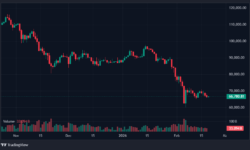




- Bitcoin fell below US$67,000 (AU$93,800) on June 2 in its steepest one-day drop since February 5, pushing short-term holders to realise losses at their fastest pace since early February.
- On-chain data showed short-term holders sending 16,400 BTC to Binance at a loss and mid-sized investors moving 8,400 BTC onto the exchange, the heaviest inflows in nearly four months.
- Spot Bitcoin ETFs have shed roughly 63,000 BTC over three weeks in the second-largest outflow streak on record, leaving the US$60,000 February low back in play.
Bitcoin (BTC) dropped below US$67,000 (AU$93K) on June 2 in its sharpest one-day decline since February 5, driving recent buyers to sell at a loss at the fastest pace in nearly four months and reviving fears of a retest of the year’s lows.
The token traded around US$66,500 (AU$93K) during US afternoon hours, down roughly 6% over 24 hours from an earlier-month peak near US$83,000 (AU$116,200).
Derivatives markets absorbed the shock, with about US$700 million (AU$980 million) in Bitcoin positions liquidated over the same window, part of a broader US$1.3 billion (AU$1.82 billion) flush that ranked as the largest since the early-February plunge.
Read more: Dimon Declares War on Crypto Bill, Slams Coinbase CEO as Senate Vote Looms
Recent Buyers Capitulate
The selling concentrated among short-term holders, wallets that acquired coins recently and are most exposed to drawdowns. CryptoQuant data showed those holders realising losses at their quickest pace since Feb. 6, with 16,400 BTC sent to Binance at a loss on June 2 alone.
Mid-sized investors added another 8,400 BTC of inflows, the highest reading since early February, while the exchange’s 30-day retail inflow total reached US$9.2 billion (AU$12.88 billion) on June 1, its highest since November.
Rising exchange inflows typically signal intent to sell, and the eight-hour relative strength index slid to 30.4, its lowest since February, pointing to oversold but still-pressured conditions. Open interest held around 288,000 BTC and funding rates stayed marginally positive at 0.083%, suggesting leveraged traders had not yet flipped decisively bearish even as spot sellers pressed.
The pattern echoes February, when a comparable burst of short-term holder losses preceded a brief flush to US$60,000 (AU$84K). Such capitulation has historically clustered near local bottoms, though analysts cautioned that elevated inflows and weak spot demand leave little immediate cushion.
Persistent outflows from spot Bitcoin exchange-traded funds have compounded the slide, with roughly 63,000 BTC withdrawn over three weeks in what data ranked as the second-largest outflow streak on record.
Read more: JPMorgan: Bitcoin, Gold ‘Debasement Trade’ Losing Steam as ETF Outflows Rise
The post Bitcoin Slide Sparks Biggest Short-Term Holder Losses Since February appeared first on Crypto News Australia.