




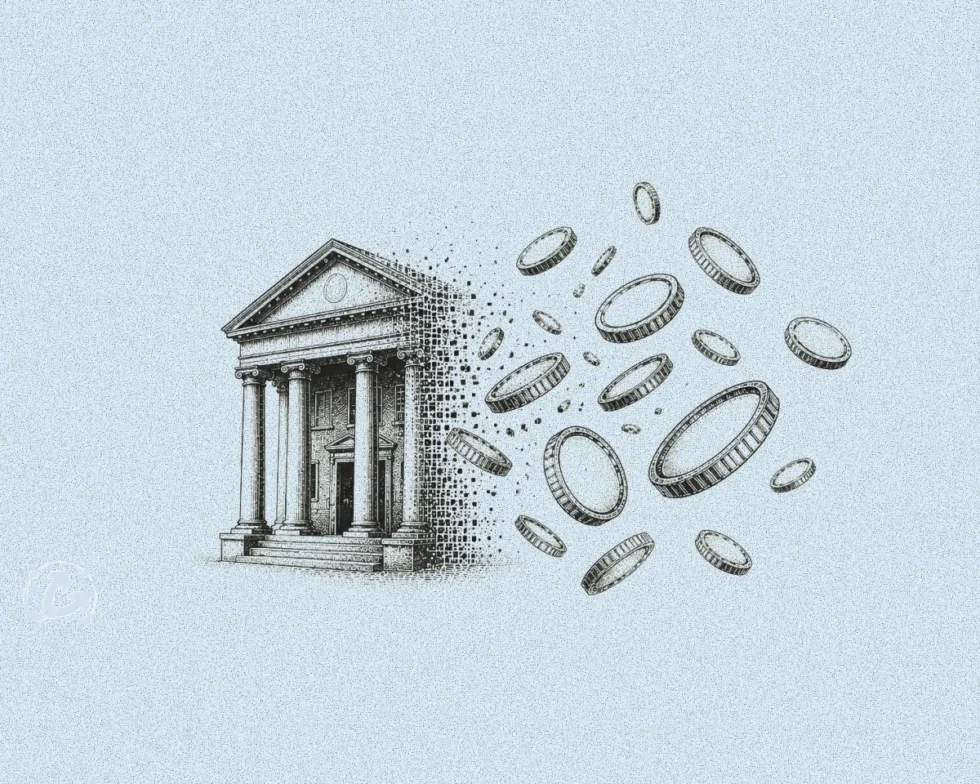

Widespread adoption of tokenized deposits could change banks’ funding models, and instant transfers between institutions may reduce the stability of that funding base and constrain lending, economists at the Federal Reserve Bank of Dallas Rozi Levi and Shrini Ramaswami said.
Tokenized deposits are a digital form of bank liabilities issued on distributed ledger infrastructure. Unlike most stablecoins, they remain within the existing banking system and can pay interest to holders.
Real-time settlement is considered one of the technology’s advantages. However, the economists also flagged a potential downside for banks.
Today, some deposits remain relatively stable due to the client’s relationship with the bank and technical frictions that hinder rapid movement of funds. These balances allow banks to forecast how long money will stay on balance sheet.
Tokenization could reduce those frictions. Clients could move funds more quickly to a bank offering a higher rate, and programmable features could automate such transfers.
The authors separately highlighted AI agents. Combined with smart contracts, they could theoretically monitor yields and shift tokenized deposits between banks without direct action by the owner.

Model shows impact up to $700 billion
Levi and Ramaswami assessed how changes in deposit behavior could affect maturity transformation. By their estimates, about 80% of the interest rate risk that U.S. banks take when holding long-term assets is currently supported by deposit characteristics. That equals roughly $5.8 trillion of a total $7 trillion such exposure.
If the average time deposits remain on bank balance sheets falls by 10%, banks’ aggregate capacity to take interest rate risk would decrease by about $580 billion in 10-year asset equivalents.
A 10% increase in the sensitivity of deposit rates to market rates would have an even larger effect: about $700 billion in 10-year asset equivalents, according to the model.
These amounts do not imply a direct reduction in lending of $580 billion or $700 billion. The metric reflects how much less interest rate risk banks could hold after converting exposures to the equivalent of 10-year U.S. Treasuries.
Banks could offset part of the effect by raising longer-term funding, for example. However, such debt typically costs more than deposits.
“This will likely negatively affect the cost of credit for consumers and businesses,” the authors noted.
Banks will have to hold more liquid assets
Another potential consequence is a shift in bank balance sheet structure. If tokenized deposits let clients withdraw significant sums almost instantly, it will become harder for institutions to forecast daily outflows. In stress scenarios, regulatory models may also begin to treat such liabilities as less stable.
As a result, banks would need to increase holdings of high-quality liquid assets (primarily reserves and U.S. Treasuries), which could reduce the share of funds available for less liquid assets, including loans to businesses and households.
At the system level, the overall deposit base may not shrink. Money could simply move faster between individual institutions. The risk arises because each bank would find it harder to rely on the stability of its own balances.
As a rough analog, the authors examined Brazil’s instant payments system Pix. It enables real-time, around-the-clock transfers between banks.
By the first quarter of 2026, the system had about 200 million active users, and monthly transaction volume reached roughly $650 billion. A 2025 study by the Central Bank of Brazil found that greater use of Pix coincided with higher holdings of liquid assets at banks, primarily government bonds, and reduced credit intermediation.
Dallas Fed economists emphasized that Pix is not a full analogue of tokenized deposits. However, both technologies allow near-instant transfers between banks, so Brazil’s experience may offer insight into potential outcomes.

Banks accelerate deposit tokenization
The analysis comes amid faster development of bank projects involving tokenized money. On August 26, 39 state banking associations formed the BankChain alliance. It plans to launch a nationwide blockchain network in 2027 with support for tokenized deposits, stablecoins and programmable settlement.
In June, JPMorgan Chase, Citigroup, Bank of America, Wells Fargo and other financial institutions announced the creation of their own infrastructure for bank on-chain money through The Clearing House.
On August 19, HSBC and Standard Chartered conducted the first real interbank transaction with tokenized deposits on SWIFT’s blockchain infrastructure. The service is intended to enable 24/7 settlement between banks and more efficient liquidity management.
The authors of the study believe the field is still at an early stage. Potential outcomes will depend on system architecture, rules for interaction between banks and how widely tokenized deposits can circulate across different issuers.
In July, the ForkLog editorial team examined how tokenized deposits work and how they differ from stablecoins.