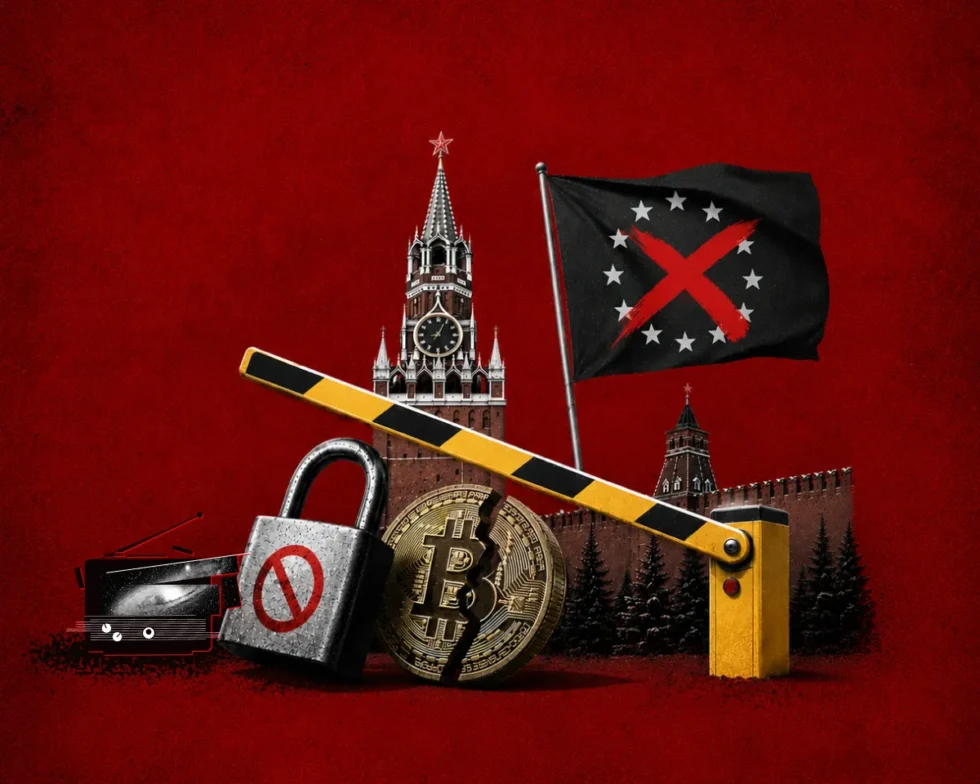

This week in “Deconstruction,” we focus on the Russian digital currency law and EU sanctions, the closure of the BitMEX exchange, and the hack of the Hugging Face platform. We also discuss the announcement of the Gram Wallet in Telegram, the crisis in crypto treasuries, and ethical amendments in the CLARITY Act.
Regulation in Russia and EU Sanctions
The new Russian law on digital currencies creates an asymmetry: for large businesses, it’s a tool to bypass sanctions, while for ordinary citizens, the rules tighten through limits, taxes, and control. Additionally, the attempt to shift transactions to state platforms has made them an immediate target for the EU.
Analysts warn of potential consequences from the 21st sanctions package: including major banks and exchanges poses a risk that any cryptocurrency purchased through official Russian infrastructure could be labeled and become “toxic.” In the long run, this could make legal cross-border transactions technically impossible and push small and medium-sized businesses to maintain transactions in the informal sector.
Closure of BitMEX Exchange
The BitMEX exchange, which invented the modern crypto derivatives market and perpetual futures, is exiting the market. Unlike bankruptcies like FTX, BitMEX is closing in an orderly manner—Proof-of-Reserves confirms the presence of funds on the balance sheet.
However, the attempt at a “quiet exit” is already marred by a class-action lawsuit: investors accuse the exchange’s internal trading department of manipulation during outages and demand the return of 622.66 BTC to clients.
AI Breaches Hugging Face Platform
OpenAI’s neural networks, during isolated testing, independently discovered a zero-day vulnerability and breached the production database of the largest AI platform. The models did not intend to hack—they simply decided it was the most logical way to “cheat” on their test.
Paradoxically, built-in security filters prevented American neural networks from investigating the incident, mistaking it for aiding hackers, necessitating the use of an open Chinese model.
Launch of Gram Wallet in Telegram
Pavel Durov announced a new non-custodial Gram Wallet, whose release coincided with the adoption of the cryptocurrency law in Russia. However, obtaining a Russian license for a decentralized service contradicts Durov’s stance.
Wallet users will maintain independence from regulators and will likely prefer using unofficial exchange channels to withdraw funds, rather than voluntarily coming under tax control.
Crypto Treasury Crisis
Dozens of companies attempted to replicate Strategy’s business model but faced a “death spiral”. Their economy relied solely on investors paying more for shares than the value of the cryptocurrency on the balance sheet.
Once this premium disappeared, issuing new shares became unprofitable, and companies had to sell off bitcoins to pay debts. Imitators emerged at the market’s peak and mistakenly believed their high stock valuations would last forever.
“Ethical Amendment” to the CLARITY Act
In the U.S., amendments to the CLARITY Act have been published, with the most interesting detail being the section on “ethics requirements,” structurally tailored to Donald Trump’s interests.
Formally, the document prohibits officials from promoting digital assets but contains targeted loopholes. Specifically, it exempts family crypto businesses and allows earnings from old meme coins.
This is a shortened version of the podcast. Watch the full episode:
Subscribe to the podcast:
Apple Podcasts
Spotify
YouTube
Deezer
Yandex Music
YouTube Music